exported
necessary
thermowell
IRI:
http://www.inf.ufrgs.br/ontologies/copi#Thermowell
Generated on 2026-04-16
Natural Language Definition
EN
A thermowell is an instrument that is a pressure-tight receptacle adapted to receive a temperature sensing element, provided with external threads or other means for pressure-tight attachment to a vessel or pipe.
PT-BR
Um poço termométrico é um instrumento que é um receptáculo resistente à pressão adaptado para receber um elemento sensor de temperatura, provido com roscas externas ou outros meios para fixação resistente à pressão a um vaso ou tubulação.
Formal Axioms
Semi-formal (Aristotelian)
Every thermowell is an instrument that has a pressure-tight receptacle as component part and has a process connection as component part and is designed for temperature sensing elements.
First-Order Logic Theory
Loading…
▸ Stored override
∀x (Thermowell(x) → Instrument(x) ∧ ∃r,c,f (PressureTightReceptacle(r) ∧ ProcessConnection(c) ∧ TemperatureSensorProtectionFunction(f) ∧ hasComponentPartAtAllTimes(x,r) ∧ hasComponentPartAtAllTimes(x,c) ∧ bearerOf(x,f)))
OWL 2 / Turtle
@prefix copi: <https://www.inf.ufrgs.br/ontologies/copi/> .
@prefix : <https://www.inf.ufrgs.br/ontologies/copi/> .
@prefix owl: <http://www.w3.org/2002/07/owl#> .
@prefix rdf: <http://www.w3.org/1999/02/22-rdf-syntax-ns#> .
@prefix rdfs: <http://www.w3.org/2000/01/rdf-schema#> .
@prefix xsd: <http://www.w3.org/2001/XMLSchema#> .
@prefix bfo: <http://purl.obolibrary.org/obo/> .
@prefix iof-core: <https://spec.industrialontologies.org/ontology/construct/> .
@prefix iof-av: <https://spec.industrialontologies.org/ontology/annotation/> .
@prefix skos: <http://www.w3.org/2004/02/skos/core#> .
@prefix qudt: <http://qudt.org/schema/qudt/> .
@prefix dcterms: <http://purl.org/dc/terms/> .
@prefix foaf: <http://xmlns.com/foaf/0.1/> .
@prefix apv: <http://inf.ufrgs.br/ontologies/apv#> .
### COPI — Core Ontology for Petroleum Installations
### Class module: Thermowell
<https://www.inf.ufrgs.br/ontologies/copi>
rdf:type owl:Ontology ;
dcterms:title "Core Ontology for Petroleum Installations (COPI)"@en ;
dcterms:title "Ontologia Core para Instalações de Petróleo (COPI)"@pt-br ;
dcterms:description "BFO/IOF-Core conformant ontology of equipment classes for petroleum production plants, developed using the five-step RDL enrichment method."@en ;
skos:scopeNote "Material artifacts (bfo:material_entity) that (i) are part of a petroleum production plant, and (ii) bear at least one function whose realization involves the transport (e.g. production and injection), processing (separation and other processes), control, monitoring, measurement, containment or offloading of material or energy."@en ;
skos:scopeNote "Artefatos materiais (bfo:material_entity) que (i) fazem parte de uma planta de produção de petróleo, e (ii) possuem ao menos uma função cuja realização envolve o transporte (p. ex. produção e injeção), processamento (separação e outros processos), controle, monitoramento, medição, contenção ou escoamento de material ou energia."@pt-br ;
skos:scopeNote "COPI provides high-level equipment categories defined by function to demonstrate the defined-class mechanism. Equipment subtypes are annotated with references to CFIHOS and PCA RDL terms. COPI is not a reference data library; organizations should use CFIHOS, PCA RDL, or ISO 14224 for comprehensive equipment classification."@en ;
skos:scopeNote "COPI fornece categorias de alto nível de equipamentos definidas por função para demonstrar o mecanismo de classe definida. Os subtipos de equipamentos são anotados com referências aos termos do CFIHOS e do PCA RDL. COPI não é uma biblioteca de dados de referência; organizações devem utilizar o CFIHOS, o PCA RDL ou a ISO 14224 para classificação abrangente de equipamentos."@pt-br ;
owl:versionInfo "1.1.0" ;
owl:imports <https://spec.industrialontologies.org/ontology/core/Core/> ;
owl:imports <http://purl.obolibrary.org/obo/bfo/2020/bfo.owl> ;
dcterms:creator "Nicolau Oyhenard dos Santos"@en ;
dcterms:contributor "Cauã Antunes" ;
dcterms:contributor "Haroldo Rojas" ;
dcterms:contributor "Rafael Petry" ;
dcterms:contributor "Régis Romeu" ;
dcterms:contributor "Mara Abel" ;
dcterms:isPartOf <https://inf.ufrgs.br/projetos/OntoKG> ;
dcterms:publisher "Universidade Federal do Rio Grande do Sul (UFRGS)"@en ;
dcterms:license <https://creativecommons.org/licenses/by/4.0/> ;
dcterms:created "2026-04-08"^^xsd:date ;
dcterms:modified "2026-10-08"^^xsd:date ;
apv:GlobalMinLanguageCoverage "en pt-br" ;
apv:ClassURIFormationRule "https://www[.]inf[.]ufrgs[.]br/ontologies/copi/(COPI_[0-9]{7}|[A-Z][A-Za-z0-9]*)" ;
apv:ClassMinAnnotationCoverage "rdfs:label https://spec.industrialontologies.org/ontology/annotation/naturalLanguageDefinition" .
iof-av:naturalLanguageDefinition rdf:type owl:AnnotationProperty ;
apv:MinAnnotationLength 20 .
### Identity-giving function
:COPI_0000201 rdf:type owl:Class ; # TemperatureSensorProtectionFunction
rdfs:subClassOf iof-core:DesignedFunction ;
rdfs:subClassOf [
rdf:type owl:Restriction ;
owl:onProperty bfo:BFO_0000054 ; # realizedIn
owl:allValuesFrom :COPI_0000667 # TemperatureSensorProtectionProcess
] ;
rdfs:subClassOf [
rdf:type owl:Restriction ;
owl:onProperty bfo:BFO_0000054 ; # realizedIn
owl:someValuesFrom :COPI_0000667 # TemperatureSensorProtectionProcess
] ;
rdfs:label "temperature sensor protection function"@en ;
rdfs:label "função de proteção de sensor de temperatura"@pt-br .
### Process type
:COPI_0000667 rdf:type owl:Class ; # TemperatureSensorProtectionProcess
rdfs:subClassOf iof-core:PlannedProcess ;
rdfs:label "temperature sensor protection process"@en ;
rdfs:label "processo de proteção de sensor de temperatura"@pt-br .
:COPI_0000667 # TemperatureSensorProtectionProcess
rdfs:subClassOf [
rdf:type owl:Restriction ;
owl:onProperty iof-core:hasInput ;
owl:someValuesFrom :COPI_0000633 # SensingElement
] ;
rdfs:subClassOf [
rdf:type owl:Restriction ;
owl:onProperty iof-core:hasSpecifiedOutput ;
owl:someValuesFrom :COPI_0000633 # SensingElement
] .
### Equipment universal: Thermowell
:COPI_0000156 rdf:type owl:Class ; # Thermowell
rdfs:subClassOf :COPI_0000091 ; # Instrument
rdfs:subClassOf [
rdf:type owl:Restriction ;
owl:onProperty iof-core:hasFunction ; # Object branch (MaterialArtifact/Assembly/Object/FiatObjectPart)
owl:someValuesFrom :COPI_0000201 # TemperatureSensorProtectionFunction
] ;
rdfs:label "thermowell"@en ;
rdfs:label "poço termométrico"@pt-br ;
iof-av:naturalLanguageDefinition "A thermowell is an instrument that is a pressure-tight receptacle adapted to receive a temperature sensing element, provided with external threads or other means for pressure-tight attachment to a vessel or pipe."@en ;
skos:definition "A thermowell is an instrument that is a pressure-tight receptacle adapted to receive a temperature sensing element, provided with external threads or other means for pressure-tight attachment to a vessel or pipe."@en ;
iof-av:naturalLanguageDefinition "Um poço termométrico é um instrumento que é um receptáculo resistente à pressão adaptado para receber um elemento sensor de temperatura, provido com roscas externas ou outros meios para fixação resistente à pressão a um vaso ou tubulação."@pt-br ;
iof-av:semiFormalNaturalLanguageAxiom "Every thermowell is an instrument that has a pressure-tight receptacle as component part and has a process connection as component part and is designed for temperature sensing elements."@en ;
iof-av:firstOrderLogicAxiom "∀x (Thermowell(x) → Instrument(x) ∧ ∃r,c,f (PressureTightReceptacle(r) ∧ ProcessConnection(c) ∧ TemperatureSensorProtectionFunction(f) ∧ hasComponentPartAtAllTimes(x,r) ∧ hasComponentPartAtAllTimes(x,c) ∧ bearerOf(x,f)))"@en ;
iof-av:isPrimitive "true"^^xsd:boolean ;
iof-av:primitiveRationale "Thermowell has constructive classification basis. The structural differentia (pressure-tight receptacle with process connection) defines necessary conditions, but making these sufficient under OWA could lead to false classifications of other threaded pressure-tight devices that happen to contain receptacles but are not intended as thermowells."@en ;
skos:definition "[ISO 15926-4] A <THERMOWELL> is an <INSTRUMENT COMPONENT> that is a pressure-tight receptacle adapted to receive a temperature sensing element, provided with external threads or other means for pressure-tight attachment to a vessel or pipe"@en ;
skos:definition "[CFIHOS] A physical object that is a pressure-tight receptacle adapted to receive a temperature sensing element, provided with external threads or other means for pressure-tight attachment to a vessel or pipe."@en ;
skos:definition "[POSC Caesar] An 'artefact' that is a pressure-tight receptacle adapted to receive a temperature sensing element, provided with external threads or other means for pressure-tight attachment to a vessel or pipe"@en .
# Disjointness: Thermowell and Actuator
[] rdf:type owl:AllDisjointClasses ;
owl:members ( :COPI_0000156 :COPI_0000207 ) . # Thermowell, Actuator
Axiomatization Decision Log
1
Identity-Giving Function
Function class
TemperatureSensorProtectionFunction
⊑ DesignedFunction
Realized in
TemperatureSensorProtectionProcess
⊑ PlannedProcess
A thermowell's identity-giving function is to provide a pressure-tight protective housing for temperature sensing elements, allowing safe temperature measurement while protecting the sensor from process conditions.
✓
Expert review — Accepted
2
Genus Determination
Instrument
All three sources classify thermowell as an instrument component or part of instrumentation. While 'Instrument' is not explicitly in the parent_candidates, it is the most appropriate genus as thermowells are instrumentation accessories. The closest parent_candidate 'INSTRUMENT COMPONENT' suggests this classification. Thermowell is more specific than MaterialArtifact but belongs to the instrumentation domain.
✓
Expert review — Accepted
"bfo_root: Assembly → MaterialArtifact — thermowell is a single machined component, not a multi-part assembly"
3
Necessary Parts
No necessary parts recorded (concept may be primitive at this level).
These three parts are structurally necessary for any thermowell: the stem provides process penetration, the receptacle houses the sensor, and the process connection enables safe installation.
✓
Expert review — Accepted
4
Process Participation Signature ⟨I, O, T⟩
Inputs (I)
SensingElement
— compatible with receptacle dimensions
Outputs (O)
SensingElement
— isolated from process pressure
Transformation (T)
physical protection and pressure isolation of temperature sensor
Thermowells provide passive protection transformation - they take an exposed temperature sensor and output a protected sensor that can safely measure temperature while being isolated from process pressure and fluid contact.
✓
Expert review — Accepted
5
Axiom Mode Decision
Necessary conditions only
— modelled as a primitive universal
(⊑, SubClassOf). Identity is grounded in designed
function and cannot be reduced to a property checklist.
Thermowell has constructive classification basis. The structural differentia (pressure-tight receptacle with process connection) defines necessary conditions, but making these sufficient under OWA could lead to false classifications of other threaded pressure-tight devices that happen to contain receptacles but are not intended as thermowells.
✓
Expert review — Accepted
Disjointness Axioms
Actuator
C4: Actuator. Thermowells are passive protective devices with no signal transmission, actuation, or control capabilities. Their process signature (physical protection) is incompatible with active instrumentation functions.
Cross-Standard Observations
All three standards (ISO 15926, CFIHOS, POSC Caesar) provide nearly identical definitions focusing on the pressure-tight receptacle and attachment means. This strong consistency across standards indicates a well-established concept definition. The classification as 'instrument component' vs 'artefact' differs slightly but all recognize the instrumentation domain.
Source Definitions
3 sources
ISO 15926-4
THERMOWELL ↗
Definition text withheld (copyrighted standard) — follow the source link above.
CFIHOS
thermowell
Definition text withheld (copyrighted standard) — follow the source link above.
POSC Caesar
Thermowell ↗
Definition text withheld (copyrighted standard) — follow the source link above.
Metadata
| Ontology | COPI |
| Research group | INF-UFRGS-Ontologies |
| Funding | CNPq INF-UFRGS-ENERGIA |
| Project | OntoKG / Petrobras |
| ID | #196 |
| Cluster | thermowell |
| Status | exported |
| Axiom mode | necessary |
| Created | 2026-04-16 |
| Updated | 2026-09-08 |
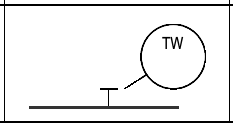
ISA 5.1-2022 P&ID Symbol
5_2_3/052_thermowell_flanged.png