exported
equivalent
well
IRI:
http://www.inf.ufrgs.br/ontologies/copi#Well
Generated on 2026-04-14
Natural Language Definition
EN
A well is an engineered system that interacts with subsurface resources through a drilled wellbore, designed to obtain, produce, store, or inject materials into or from the earth.
PT-BR
Um poço é um sistema projetado que interage com recursos do subsolo através de um furo perfurado, projetado para obter, produzir, armazenar ou injetar materiais na terra ou a partir dela.
Formal Axioms
Semi-formal (Aristotelian)
Every well is an engineered system that bears a subsurface resource interaction function and has a wellbore as component part.
First-Order Logic Theory
Loading…
▸ Stored override
∀x(Well(x) ↔ EngineeredSystem(x) ∧ ∃f(SubsurfaceResourceInteractionFunction(f) ∧ bearerOf(x,f)) ∧ ∃w(Wellbore(w) ∧ hasComponentPartAtSomeTime(x,w)))
OWL 2 / Turtle
@prefix copi: <https://www.inf.ufrgs.br/ontologies/copi/> .
@prefix : <https://www.inf.ufrgs.br/ontologies/copi/> .
@prefix owl: <http://www.w3.org/2002/07/owl#> .
@prefix rdf: <http://www.w3.org/1999/02/22-rdf-syntax-ns#> .
@prefix rdfs: <http://www.w3.org/2000/01/rdf-schema#> .
@prefix xsd: <http://www.w3.org/2001/XMLSchema#> .
@prefix bfo: <http://purl.obolibrary.org/obo/> .
@prefix iof-core: <https://spec.industrialontologies.org/ontology/construct/> .
@prefix iof-av: <https://spec.industrialontologies.org/ontology/annotation/> .
@prefix skos: <http://www.w3.org/2004/02/skos/core#> .
@prefix qudt: <http://qudt.org/schema/qudt/> .
@prefix dcterms: <http://purl.org/dc/terms/> .
@prefix foaf: <http://xmlns.com/foaf/0.1/> .
@prefix apv: <http://inf.ufrgs.br/ontologies/apv#> .
### COPI — Core Ontology for Petroleum Installations
### Class module: Well
<https://www.inf.ufrgs.br/ontologies/copi>
rdf:type owl:Ontology ;
dcterms:title "Core Ontology for Petroleum Installations (COPI)"@en ;
dcterms:title "Ontologia Core para Instalações de Petróleo (COPI)"@pt-br ;
dcterms:description "BFO/IOF-Core conformant ontology of equipment classes for petroleum production plants, developed using the five-step RDL enrichment method."@en ;
skos:scopeNote "Material artifacts (bfo:material_entity) that (i) are part of a petroleum production plant, and (ii) bear at least one function whose realization involves the transport (e.g. production and injection), processing (separation and other processes), control, monitoring, measurement, containment or offloading of material or energy."@en ;
skos:scopeNote "Artefatos materiais (bfo:material_entity) que (i) fazem parte de uma planta de produção de petróleo, e (ii) possuem ao menos uma função cuja realização envolve o transporte (p. ex. produção e injeção), processamento (separação e outros processos), controle, monitoramento, medição, contenção ou escoamento de material ou energia."@pt-br ;
skos:scopeNote "COPI provides high-level equipment categories defined by function to demonstrate the defined-class mechanism. Equipment subtypes are annotated with references to CFIHOS and PCA RDL terms. COPI is not a reference data library; organizations should use CFIHOS, PCA RDL, or ISO 14224 for comprehensive equipment classification."@en ;
skos:scopeNote "COPI fornece categorias de alto nível de equipamentos definidas por função para demonstrar o mecanismo de classe definida. Os subtipos de equipamentos são anotados com referências aos termos do CFIHOS e do PCA RDL. COPI não é uma biblioteca de dados de referência; organizações devem utilizar o CFIHOS, o PCA RDL ou a ISO 14224 para classificação abrangente de equipamentos."@pt-br ;
owl:versionInfo "1.1.0" ;
owl:imports <https://spec.industrialontologies.org/ontology/core/Core/> ;
owl:imports <http://purl.obolibrary.org/obo/bfo/2020/bfo.owl> ;
dcterms:creator "Nicolau Oyhenard dos Santos"@en ;
dcterms:contributor "Cauã Antunes" ;
dcterms:contributor "Haroldo Rojas" ;
dcterms:contributor "Rafael Petry" ;
dcterms:contributor "Régis Romeu" ;
dcterms:contributor "Mara Abel" ;
dcterms:isPartOf <https://inf.ufrgs.br/projetos/OntoKG> ;
dcterms:publisher "Universidade Federal do Rio Grande do Sul (UFRGS)"@en ;
dcterms:license <https://creativecommons.org/licenses/by/4.0/> ;
dcterms:created "2026-04-08"^^xsd:date ;
dcterms:modified "2026-10-08"^^xsd:date ;
apv:GlobalMinLanguageCoverage "en pt-br" ;
apv:ClassURIFormationRule "https://www[.]inf[.]ufrgs[.]br/ontologies/copi/(COPI_[0-9]{7}|[A-Z][A-Za-z0-9]*)" ;
apv:ClassMinAnnotationCoverage "rdfs:label https://spec.industrialontologies.org/ontology/annotation/naturalLanguageDefinition" .
iof-av:naturalLanguageDefinition rdf:type owl:AnnotationProperty ;
apv:MinAnnotationLength 20 .
### Identity-giving function
:COPI_0000655 rdf:type owl:Class ; # SubsurfaceResourceInteractionFunction
rdfs:subClassOf iof-core:DesignedFunction ;
rdfs:subClassOf [
rdf:type owl:Restriction ;
owl:onProperty bfo:BFO_0000054 ; # realizedIn
owl:allValuesFrom :COPI_0000656 # SubsurfaceResourceInteractionProcess
] ;
rdfs:subClassOf [
rdf:type owl:Restriction ;
owl:onProperty bfo:BFO_0000054 ; # realizedIn
owl:someValuesFrom :COPI_0000656 # SubsurfaceResourceInteractionProcess
] ;
rdfs:label "subsurface resource interaction function"@en ;
rdfs:label "função de interação com recursos subsuperficiais"@pt-br .
### Process type
:COPI_0000656 rdf:type owl:Class ; # SubsurfaceResourceInteractionProcess
rdfs:subClassOf iof-core:PlannedProcess ;
rdfs:label "subsurface resource interaction process"@en ;
rdfs:label "processo de interação com recursos subsuperficiais"@pt-br .
:COPI_0000656 # SubsurfaceResourceInteractionProcess
rdfs:subClassOf [
rdf:type owl:Restriction ;
owl:onProperty iof-core:hasInput ;
owl:someValuesFrom bfo:BFO_0000040 # MaterialEntity
] ;
rdfs:subClassOf [
rdf:type owl:Restriction ;
owl:onProperty iof-core:hasSpecifiedOutput ;
owl:someValuesFrom bfo:BFO_0000040 # MaterialEntity
] .
### Equipment universal: Well
:COPI_0000375 rdf:type owl:Class ; # Well
owl:equivalentClass [
rdf:type owl:Class ;
owl:intersectionOf (
iof-core:EngineeredSystem
[
rdf:type owl:Restriction ;
owl:onProperty bfo:BFO_0000196 ; # bearerOf — ObjectAggregate branch
owl:someValuesFrom :COPI_0000655 # SubsurfaceResourceInteractionFunction
]
)
] ;
rdfs:label "well"@en ;
rdfs:label "poço"@pt-br ;
iof-av:naturalLanguageDefinition "A well is an engineered system that interacts with subsurface resources through a drilled wellbore, designed to obtain, produce, store, or inject materials into or from the earth."@en ;
skos:definition "A well is an engineered system that interacts with subsurface resources through a drilled wellbore, designed to obtain, produce, store, or inject materials into or from the earth."@en ;
iof-av:naturalLanguageDefinition "Um poço é um sistema projetado que interage com recursos do subsolo através de um furo perfurado, projetado para obter, produzir, armazenar ou injetar materiais na terra ou a partir dela."@pt-br ;
iof-av:semiFormalNaturalLanguageAxiom "Every well is an engineered system that bears a subsurface resource interaction function and has a wellbore as component part."@en ;
iof-av:firstOrderLogicAxiom "∀x(Well(x) ↔ EngineeredSystem(x) ∧ ∃f(SubsurfaceResourceInteractionFunction(f) ∧ bearerOf(x,f)) ∧ ∃w(Wellbore(w) ∧ hasComponentPartAtSomeTime(x,w)))"@en ;
skos:definition "[ISO 15926-4] A <WELL> is a <FunctionalObject> that is arranged to obtain or produce from, or store or inject a material into, the earth"@en ;
skos:definition "[CFIHOS] A well is a collection of (zero or more) holes drilled into the Earth for the purpose of either (1) finding or producing underground resources; or (2) providing services related to the production of underground resources."@en ;
skos:definition "[PPDM] A Well is a permitted or actual drilled hole in the ground designed to exchange (or facilitate the exchange of) fluids between a subsurface reservoir and the surface (or another reservoir), or to enable the detection and measurement of rock properties. Key concept: A physical Well is created each time the drill bit breaks the surface of the earth. Clarification: A Well is the parent of the Wellhead Stream(s), Well Origin, and all Well Components down hole from its Well Origin. A Well has a single Well Origin and all Wellbore(s) that extend from this Well Origin are parts of the Well. Re-entry through the same Well Origin for a Well that has not been plugged and abandoned does not create a new Well. A Well that has the same geographic coordinates as a previously existing plugged and abandoned, reclaimed or undrilled Well is a new Well. WB2-Cl2 Diagram Note: The Well depicted on page 3 groups multiple Well Components, including: one active Well WB2-C1 Origin (WO1), one inactive Wellbore (WB1), two active Wellbores (WB2, WB3), three inactive Wellbore Completions (WB1-C1, WB1-C2, WB1-C3) and three active Wellbore Completions (WB2-C1, WB3-C1, WB3-C2) and two active Wellbore Contact Intervals (WB2- CI1, WB2-CI2). ® Copyright 2014, PPDM Association. All Rights Reserved PAGE 4"@en .
# Disjointness: Well and Pipeline
[] rdf:type owl:AllDisjointClasses ;
owl:members ( :COPI_0000375 :COPI_0000326 ) . # Well, Pipeline
# Disjointness: Well and StorageTank
[] rdf:type owl:AllDisjointClasses ;
owl:members ( :COPI_0000375 :COPI_0000151 ) . # Well, StorageTank
Axiomatization Decision Log
1
Identity-Giving Function
Function class
SubsurfaceResourceInteractionFunction
⊑ DesignedFunction
Realized in
SubsurfaceResourceInteractionProcess
⊑ PlannedProcess
The identity-giving function encompasses the full scope of well operations: obtaining/producing resources from the earth, or storing/injecting materials into the earth. This is what distinguishes a well from other equipment - its designed purpose to interact with subsurface formations and resources.
2
Genus Determination
EngineeredSystem
bfo:ObjectAggregate (BFO_0000027)
Collection of interacting Objects with a designed function.
EngineeredSystem ≡ System ⊓ ∃bearerOf.DesignedFunction,
where System ⊑ bfo:ObjectAggregate.
No single causal boundary spans all member objects.
A well is fundamentally a collection of interacting components (wellbore, casing, completion equipment, surface facilities) that work together but lack a single causal boundary. The CFIHOS definition explicitly states 'collection of holes' and 'services related to production', indicating an aggregate system rather than a single unified object. Wells span from surface to subsurface with multiple distinct subsystems.
3
Necessary Parts
No necessary parts recorded (concept may be primitive at this level).
The wellbore is the only universal component - all other parts (casing, completion equipment, surface facilities) vary significantly by well type, purpose, and completion design. Used hasComponentPartAtSomeTime because wells may be temporarily without surface equipment during drilling or workover operations.
4
Process Participation Signature ⟨I, O, T⟩
Inputs (I)
MaterialEntity
— injected fluids, drilling fluids, or completion fluids
Outputs (O)
MaterialEntity
— produced hydrocarbons, water, gas, or other subsurface materials
Transformation (T)
subsurface material extraction or injection - transfer between surface and underground formations
Wells can operate in production mode (outputs), injection mode (inputs), or service mode (bidirectional). The signature is highly flexible as wells serve diverse purposes from exploration to disposal.
5
Axiom Mode Decision
Necessary + Sufficient
— modelled as a defined class
(≡, EquivalentClass). Automatic classification is
appropriate for this concept.
Disjointness Axioms
Pipeline
StorageTank
C2: Pipeline. C4: StorageTank. Wells interact with subsurface formations through vertical penetration, which is incompatible with horizontal fluid transport (pipelines), surface material transformation (processing plants), or contained surface storage (tanks).
Cross-Standard Observations
ISO 15926 focuses on the functional aspect ('arranged to obtain or produce'), while CFIHOS emphasizes the physical structure ('collection of holes'). Both recognize the dual purpose of resource extraction and service operations. The functional definition aligns well with the system-level nature of wells.
Source Definitions
3 sources
ISO 15926-4
WELL ↗
Definition text withheld (copyrighted standard) — follow the source link above.
CFIHOS
well
Definition text withheld (copyrighted standard) — follow the source link above.
ppdm
Well ↗
Definition text withheld (copyrighted standard) — follow the source link above.
Metadata
| Ontology | COPI |
| Research group | INF-UFRGS-Ontologies |
| Funding | CNPq INF-UFRGS-ENERGIA |
| Project | OntoKG / Petrobras |
| ID | #99 |
| Cluster | well |
| Status | exported |
| Axiom mode | equivalent |
| Created | 2026-04-14 |
| Updated | 2026-09-08 |
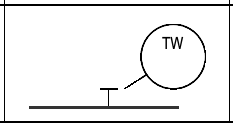
ISA 5.1-2022 P&ID Symbol
5_2_3/052_thermowell_flanged.png