Definition & axiom
⚠ Conflicts with the ISO 15926-4 primary definition
Label (EN)
pump
Label (PT-BR)
Definition (EN)
Definition (PT-BR)
Semi-formal axiom (Aristotelian)
Axiom type
LLM classification basis: function-based → ≡
All definitions center on the function of pumping or adding/removing mechanical energy to fluid. The identity of a pump is defined by its designed function to pressurize and move fluids, regardless of the physical mechanism (centrifugal, reciprocating, rotary, etc.). The numerous constructive subtypes (centrifugal pump, reciprocating pump, rotary pump) all share this core pumping function.
Validation status
Why primitive (necessary only)
Reviewer notes
FOL theory & disjointness
First-order logic theory (generated)
Loading…
Disjoint with
▸
Expert review
— accepted
Axiomatization steps
1
Identity-Giving Function
✓ done
PumpingFunction → PumpingProcess ⊑ MomentumTransfer
▼
COPI-Core operation
MomentumTransfer via process parent MomentumTransfer
LLM rationale:
The pumping function is identity-giving for all pumps - it is the designed capability to add mechanical energy to fluid to increase pressure and enable flow. This distinguishes pumps from other fluid handling equipment like valves (which control flow) or heat exchangers (which transfer thermal energy).
▸
Expert review
— accepted
2
Genus Proximus
✓ done
Assembly
▼
Genus (genus proximum)
Most specific superclass — may be a domain class like "Valve" or an IOF-Core root.
BFO/IOF-Core Root
bfo:Object branch
bfo:ObjectAggregate branch
bfo:ImmaterialEntity branch
LLM rationale:
Pumps are complex mechanical devices with multiple physically connected subcomponents (casing, impeller/pistons, shaft, seals, bearings) that can be disassembled for maintenance, but function as a single causally unified object. While 'mechanical equipment class' and 'ProcessEquipment' appear in parent candidates, these are too broad and not ontologically precise. Assembly is the most specific appropriate IOF-Core class since no domain-specific pump superclass is enriched yet.
▸
Expert review
— accepted
3
Differentia Specifica
✓ done
∃bearerOf.PumpingFunction
▼
Conditions that distinguish
Pump
from sibling classes under genus
Assembly.
Only what is not already entailed by the genus.
Differentia expression
Differentia (natural language)
LLM rationale:
The pumping function is the minimal differentiating condition that separates pumps from all other process equipment assemblies. It captures the essence across all pump types (centrifugal, reciprocating, rotary) while being distinct from compression (gas handling) and flow control (energy restriction rather than addition).
▸
Expert review
— accepted
4
Necessary Parts
✓ done
no necessary parts
▼
Consider part-whole relations beyond subsumption:
hasComponentPartAtAllTimes (universal, structurally essential)
· hasComponentPartAtSomeTime (contingent, optional component)
LLM rationale:
These parts are fundamental to the pumping function across all pump types, though their specific implementations vary (centrifugal impellers vs pistons vs gears)
▸
Expert review
— accepted
5
Process Participation Signature ⟨I, O, T⟩
✓ done
PortionOfFluid → PortionOfFluid
▼
Inputs (I)
Outputs (O)
Transformation (T)
LLM rationale:
Pumps transform a single fluid stream by adding mechanical energy to increase pressure, enabling transport and overcome system resistance
▸
Expert review
More
Alternative labels
none
▼
Synonyms / alternative labels (comma-separated) — skos:altLabel
Language auto-detected on export (PT if the label contains accents, EN otherwise).
Properties as BFO qualities
0 of 37 selected
▼
Select which CFIHOS/DEXPI properties inhere in every instance of Pump as
bfo:Quality subclasses.
Each selected property →
:PumpQuality ⊑ bfo:Quality, inheres in :Pump
Custom axioms
none
▼
Axioms not produced by the pipeline. Each is appended verbatim as an
rdfs:subClassOf restriction on Pump.
Write the restriction block in Turtle syntax (without the leading
rdfs:subClassOf).
Example: [ owl:onProperty :hasPart ; owl:someValuesFrom :Wellhead ]
Cross-standard divergences
none detected yet
▼
Click "Detect divergences" to analyse cross-standard disagreements for this cluster.
Source Definitions (4)
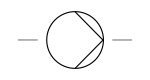
PUMP — ClassOfFunctionalObject
Definition text hidden (copyrighted standard) — sign in to view, or follow the source link above.
cfihos V2.0
pump — TagAndEquipmentClass
Definition text hidden (copyrighted standard) — sign in to view, or follow the source link above.
Pump — ConcreteClass
Definition text hidden (copyrighted standard) — sign in to view, or follow the source link above.
Pump — Class
Definition text hidden (copyrighted standard) — sign in to view, or follow the source link above.
Provenance tiers (6)
Sources the pipeline cited while building this entry. Verbatim = the quote was copied word-for-word from that source; summary = paraphrased.
standard · verbatim
standard · verbatim
standard · verbatim
Linked competency questions
- answered What is a pump?
- answered Which equipment classes in COPI have iof:Assembly as their BFO genus root?
- answered Which equipment classes in COPI are defined with equivalent (sufficient + necessary) conditions?
- answered Can the same individual be simultaneously classified as a Pump and as a Compressor?
- answered What is the identity-giving function of a centrifugal pump?
- answered What planned process does a pump necessarily participate in as the primary agent?
- open What is a drive shaft?
- open Is a drive shaft a necessary component of every pump?
- open What is a pump casing?
- open Is a pump casing a necessary component of every pump?
OWL/Turtle preview
Download .ttl
Numeric
COPI_* IRIs from copi-iri-map.tsv, with the readable name as a trailing comment. Names not yet in the map stay readable.
Loading...
ID 7 · claude-sonnet-4-20250514
Created 2026-04-09 17:10
Updated 2026-09-08 12:26
Last edited by nosantos · 2026-06-23 18:09