Definition & axiom
⚠ Conflicts with the ISO 15926-4 primary definition
Label (EN)
vessel
Label (PT-BR)
Definition (EN)
Definition (PT-BR)
Semi-formal axiom (Aristotelian)
Axiom type
LLM classification basis: function-based → ≡
The concept is defined by its intended purpose - storage and/or processing of fluids/solids. All definitions emphasize the containment function rather than specific structural mechanisms or configurations.
Validation status
Why primitive (necessary only)
Reviewer notes
FOL theory & disjointness
First-order logic theory (generated)
Loading…
Disjoint with
▸
Expert review
— accepted
Axiomatization steps
1
Identity-Giving Function
✓ done
ContainmentFunction → ContainmentProcess ⊑ MaterialContainment
▼
COPI-Core operation
MaterialContainment via process parent MaterialContainment
LLM rationale:
The identity-giving function is containment - to hold and contain fluids or solids for storage and/or processing. This is what makes a vessel a vessel rather than other equipment types.
▸
Expert review
— accepted
2
Genus Proximus
✓ done
Assembly
▼
Genus (genus proximum)
Most specific superclass — may be a domain class like "Valve" or an IOF-Core root.
BFO/IOF-Core Root
bfo:Object branch
bfo:ObjectAggregate branch
bfo:ImmaterialEntity branch
LLM rationale:
Vessels are engineered containers with physically connected parts (shells, heads, nozzles, internal components) that form a single causally unified object. They are more complex than simple MaterialArtifacts, having removable/maintainable subcomponents. No appropriate domain-specific parent exists in the enriched classes - this appears to be a fundamental equipment category.
▸
Expert review
— accepted
3
Differentia Specifica
✓ done
∃bearerOf.ContainmentFunction
▼
Conditions that distinguish
Vessel
from sibling classes under genus
Assembly.
Only what is not already entailed by the genus.
Differentia expression
Differentia (natural language)
LLM rationale:
The containment function is the minimal differentiating condition that distinguishes vessels from other assemblies. This covers both storage vessels (static containment) and process vessels (containment during processing operations).
▸
Expert review
— accepted
4
Necessary Parts
✓ done
no necessary parts
▼
Consider part-whole relations beyond subsumption:
hasComponentPartAtAllTimes (universal, structurally essential)
· hasComponentPartAtSomeTime (contingent, optional component)
LLM rationale:
These are the minimal structural components required for any vessel to fulfill its containment function - a shell for the main boundary and heads for closure.
▸
Expert review
— accepted
5
Process Participation Signature ⟨I, O, T⟩
✓ done
PortionOfFluid → PortionOfFluid
▼
Inputs (I)
Outputs (O)
Transformation (T)
LLM rationale:
Vessels can contain various fluid types and may have no inputs/outputs (storage) or multiple streams (processing). The transformation depends on the specific vessel type and application.
▸
Expert review
More
Alternative labels
none
▼
Synonyms / alternative labels (comma-separated) — skos:altLabel
Language auto-detected on export (PT if the label contains accents, EN otherwise).
Properties as BFO qualities
0 of 2 selected
▼
Select which CFIHOS/DEXPI properties inhere in every instance of Vessel as
bfo:Quality subclasses.
Each selected property →
:VesselQuality ⊑ bfo:Quality, inheres in :Vessel
Custom axioms
none
▼
Axioms not produced by the pipeline. Each is appended verbatim as an
rdfs:subClassOf restriction on Vessel.
Write the restriction block in Turtle syntax (without the leading
rdfs:subClassOf).
Example: [ owl:onProperty :hasPart ; owl:someValuesFrom :Wellhead ]
Cross-standard divergences
none detected yet
▼
Click "Detect divergences" to analyse cross-standard disagreements for this cluster.
Source Definitions (3)
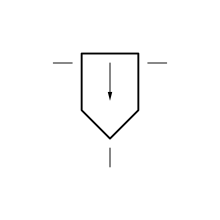
VESSEL — ClassOfFunctionalObject
Definition text hidden (copyrighted standard) — sign in to view, or follow the source link above.
cfihos V2.0
vessel — AbstractTagAndEquipmentClass
Definition text hidden (copyrighted standard) — sign in to view, or follow the source link above.
Vessel — ConcreteClass
Definition text hidden (copyrighted standard) — sign in to view, or follow the source link above.
Provenance tiers (3)
Sources the pipeline cited while building this entry. Verbatim = the quote was copied word-for-word from that source; summary = paraphrased.
Linked competency questions
- answered Which equipment classes in COPI have iof:Assembly as their BFO genus root?
- answered Which equipment classes in COPI participate in a SeparationProcess?
- answered What is the difference between a pressure vessel and a storage tank in COPI?
- open What is a vessel head?
- open Is a vessel head a necessary component of every vessel?
- open What is a vessel shell?
- open Is a vessel shell a necessary component of every vessel?
OWL/Turtle preview
Download .ttl
Numeric
COPI_* IRIs from copi-iri-map.tsv, with the readable name as a trailing comment. Names not yet in the map stay readable.
Loading...
ID 49 · claude-sonnet-4-20250514
Created 2026-04-13 22:16
Updated 2026-09-10 11:37