Definition & axiom
⚠ Conflicts with the ISO 15926-4 primary definition
Label (EN)
globe valve
Label (PT-BR)
Definition (EN)
Definition (PT-BR)
Semi-formal axiom (Aristotelian)
Axiom type
LLM classification basis: structure-based → ⊑
Globe valve is primarily defined by its physical mechanism: a disc or plug closure member operating with linear motion normal to the seat. While it serves the general valve function of flow control, its identity is given by this specific structural configuration rather than a unique function.
Validation status
Why primitive (necessary only)
Reviewer notes
FOL theory & disjointness
First-order logic theory (generated)
Loading…
Disjoint with
▸
Expert review
— accepted
Axiomatization steps
1
Identity-Giving Function
✓ done
FlowControlFunction → FlowControlProcess ⊑ FlowControl
▼
COPI-Core operation
FlowControl via process parent FlowControl
LLM rationale:
Globe valves share the same identity-giving function as the general Valve class - controlling fluid flow. The differentia comes from the specific linear motion mechanism, not a unique function type. Reusing FlowControlFunction from already-enriched valve class.
▸
Expert review
— accepted
2
Genus Proximus
✓ done
Valve · MaterialArtifact
▼
Genus (genus proximum)
Most specific superclass — may be a domain class like "Valve" or an IOF-Core root.
BFO/IOF-Core Root
bfo:Object branch
bfo:ObjectAggregate branch
bfo:ImmaterialEntity branch
LLM rationale:
Valve is the most specific appropriate superclass, already enriched in the ontology with FlowControlFunction. All sources explicitly state 'globe valve is a valve'. Globe valve is a constructive subtype that inherits the flow control function but adds specific structural constraints.
▸
Expert review
— accepted
3
Differentia Specifica
✓ done
∃hasComponentPartAtAllTimes.LinearMotionClosure ⊓ ∃hasComponentPartAtAllTimes.NormalSeat
▼
Conditions that distinguish
Globe Valve
from sibling classes under genus
Valve.
Only what is not already entailed by the genus.
Differentia expression
Differentia (natural language)
LLM rationale:
The linear motion normal to the seat is the defining structural characteristic across all sources. This differentiates from other valve mechanisms like rotational (ball, butterfly) or parallel sliding (gate) motions.
▸
Expert review
— accepted
4
Necessary Parts
✓ done
GlobeValveClosureMember
▼
Consider part-whole relations beyond subsumption:
hasComponentPartAtAllTimes (universal, structurally essential)
· hasComponentPartAtSomeTime (contingent, optional component)
LLM rationale:
Parts focus on the structural elements that implement the defining linear motion mechanism normal to the flow path, distinguishing globe valves from other valve types.
▸
Expert review
— accepted
5
Process Participation Signature ⟨I, O, T⟩
✓ done
PortionOfFluid → PortionOfFluid
▼
Inputs (I)
Outputs (O)
Transformation (T)
LLM rationale:
Globe valves modulate flow through linear positioning of closure member, providing variable restriction from fully open to fully closed positions. Single inlet/outlet with same fluid composition.
▸
Expert review
More
Alternative labels
none
▼
Synonyms / alternative labels (comma-separated) — skos:altLabel
Language auto-detected on export (PT if the label contains accents, EN otherwise).
Properties as BFO qualities
0 of 18 selected
▼
Select which CFIHOS/DEXPI properties inhere in every instance of Globe Valve as
bfo:Quality subclasses.
Each selected property →
:GlobeValveQuality ⊑ bfo:Quality, inheres in :GlobeValve
Custom axioms
none
▼
Axioms not produced by the pipeline. Each is appended verbatim as an
rdfs:subClassOf restriction on Globe Valve.
Write the restriction block in Turtle syntax (without the leading
rdfs:subClassOf).
Example: [ owl:onProperty :hasPart ; owl:someValuesFrom :Wellhead ]
Cross-standard divergences
none detected yet
▼
Click "Detect divergences" to analyse cross-standard disagreements for this cluster.
Source Definitions (4)
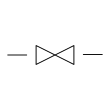
GLOBE VALVE — ClassOfInanimatePhysicalObject
Definition text hidden (copyrighted standard) — sign in to view, or follow the source link above.
cfihos V2.0
globe valve — TagAndEquipmentClass
Definition text hidden (copyrighted standard) — sign in to view, or follow the source link above.
globe valve
Definition text hidden (copyrighted standard) — sign in to view, or follow the source link above.
Globe Valve — Class
Definition text hidden (copyrighted standard) — sign in to view, or follow the source link above.
Provenance tiers (4)
Sources the pipeline cited while building this entry. Verbatim = the quote was copied word-for-word from that source; summary = paraphrased.
Linked competency questions
- answered What are all the subclasses of Valve recognised in COPI?
- answered Which equipment classes in COPI use necessary-only (primitive) conditions?
- answered What distinguishes a gate valve from a globe valve constructively?
- open What is a valve stem?
- open Which COPI equipment classes require a valve stem as a necessary component? (candidates: ball valve, gate control valve, globe control valve and globe valve)
OWL/Turtle preview
Download .ttl
Numeric
COPI_* IRIs from copi-iri-map.tsv, with the readable name as a trailing comment. Names not yet in the map stay readable.
Loading...
ID 47 · claude-sonnet-4-20250514
Created 2026-04-13 22:16
Updated 2026-09-08 16:27